

Many people have never heard of NFT tokens. NFT stands for Non-Fungible Token, a unique token (or unique certificate) that proves we are the sole owner of a specific digital file. Below, we explain what NFTs are, how they work and how to buy them.
NFT
The virtual world is closer to us than ever before. Social networks are replacing personal contact. Digital currency is booming. Thanks to a phone app, we get discounts on groceries in our favourite shop. So it is no surprise that investors have found another way into this world.
NFTs are digital assets stored on a public blockchain (a kind of digital database). They are created to represent original digital items and confirm who owns them. Examples include a virtual image, a video, a song or a collectible card. Essentially, these items can be “tokenised”, which means creating digital proof of ownership so the owner can be identified quickly.
An example makes this easier to understand. Bitcoins, as a digital currency, are fungible. One bitcoin is basically indistinguishable from another, and they have the same value. NFTs, on the other hand, are completely unique and non-fungible tokens. Each represents a one-of-a-kind item: it may have many copies, but there is only one original. Because they are unique, owners of these items earn thousands and sometimes even millions. Investing in the art market has gained a completely new dimension.
Anyone can buy an NFT on an online marketplace. We receive a certificate of ownership that protects the value of the asset. Images and other digital products spread across the internet at lightning speed and are impossible to control. Our image may have thousands of copies on different users’ computers. However, only we have the original, and the NFT lets us prove we own it. It is like having an original Rembrandt hanging at home, only in digital form. We can hold an NFT, transfer it or sell it to another owner.
What is an NFT in practice and how it works
When an NFT is created, a small program called a smart contract records a new token on a blockchain. Each token has its own identification number, so no two tokens are the same. The token is linked to metadata, which usually includes a name, a description and a link to the actual file.
Most images, videos and songs are too large to store on a blockchain directly. The file itself is often kept elsewhere, on an ordinary web server or in a decentralised storage network. The blockchain records which wallet holds the token and keeps the full history of every transfer. If the file is stored on a server that later shuts down, your token still exists but may point to nothing. Before you buy, check where the file is kept.
Owning an NFT also does not automatically give you the copyright. In most cases the creator keeps the copyright, and you get only the rights set out in the licence terms of the project. Read these terms if you plan to use the work commercially, for example on merchandise.
What is NFT art
NFT art is digital artwork sold together with a token that records its ownership. It can take many forms, such as pixel art, digital paintings, photography, animation, music or 3D models. Some collections are generative, which means a computer combines different traits to produce thousands of unique images. Creators can often set a royalty, a small share they receive each time the work is resold, although whether it is paid depends on the marketplace.
Where to buy NFTs?
There are several online marketplaces where NFTs are traded. First, we set up a crypto wallet (for example MetaMask, Enjin or Math Walle) that supports NFT ownership. Although it is not a rule, most NFT works are sold for the cryptocurrency Ether (ETH). We buy some ETH and choose a platform where we want to make the purchase (for example Foundation, OpenSea or SuperRare). Creating a crypto wallet and making a first purchase takes no more than fifteen minutes.
A few years ago, we could have bought one of the best-known pixel illustrations, CryptoPunks, for 0.2 ETH. Today the most valuable one is worth 4,200 ETH, which is roughly 164 million CZK (about 7.5 million USD).
What is an NFT marketplace
An NFT marketplace is a website or app where you can create, list, buy and sell NFTs. It connects to your crypto wallet, shows listings and carries out the transfer of the token and the payment through the blockchain. Marketplaces differ in several ways you should compare before you choose one:
- Fees. Most platforms take a percentage of each sale, and you also pay network fees for transactions.
- Supported blockchains. Some work only with Ethereum, others also support different networks with lower fees.
- Open or curated. Open platforms let anyone list work, while curated ones select the artists they accept.
- Payment options. Some accept only cryptocurrency, others also take payment cards.
How to create an NFT?
We can also create an NFT ourselves on one of the platforms mentioned above. We need a crypto wallet to pay the network fee. This fee will not be more than a few hundred CZK. We fill in the NFT details and upload the file to the marketplace. We choose whether to create a single NFT or a collection. We decide whether to put it up for auction, sell it directly or keep it in our wallet. Although it is not very common, physical collectibles can also have NFT tokens. We can also transfer our NFTs between marketplaces, as long as the platforms support our type of token.
Opportunity or risk?
This phenomenon has opened the door to making money. It is an opportunity for artists who would like to make money from their work. It is also a possible investment for fans who would happily buy, for example, a 70-year-old X-ray of William Shatner’s teeth, as its value may keep rising. Like every investment, this one has its risks. Nobody can guarantee that an NFT we buy for, say, 20,000 CZK (about 920 USD) can be sold for several times as much. A problem may also arise if the world one day decides that NFTs are no longer in fashion. We would be left with rights to worthless digital art. We also need to watch out for fraudsters who sell NFTs that never belonged to them. So before we start investing, we should weigh up all the pros and cons.
Common mistakes to avoid
- Sharing your recovery phrase. No genuine marketplace or support team will ever ask for it. Anyone who has it can empty your wallet.
- Buying copies of famous collections. Fake collections often use the same images and similar names. Check that the contract address is the official one.
- Ignoring fees. On a cheap purchase of around 50 USD, network and platform fees can take a large share of the value.
- Assuming you can always sell. Many NFTs have few or no buyers, so you may not be able to sell at any price.
- Forgetting about tax. In many countries, profits from selling NFTs are taxable. Check the rules where you live.
Bored Ape Yacht Club
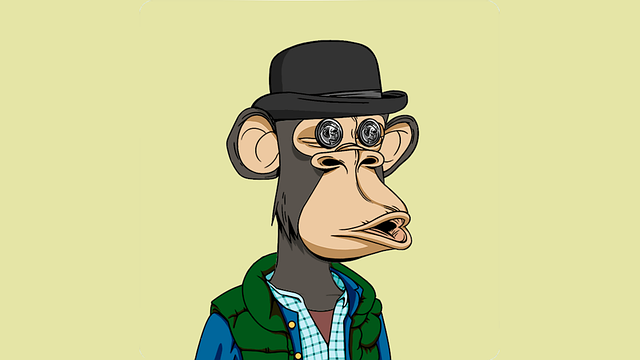
Bored Ape Yacht Club is a collection of 10,000 illustrations. Each Bored Ape is a unique, computer-generated image of a bored ape. The illustrations are created from more than 170 possible traits, including facial expression, clothing, headwear, accessories and more. The collection sold on the Sotheby´s auction portal for 24.4 million dollars. On the OpenSea online marketplace, besides animations and graphics, we can also buy magazine covers or well-known collections such as Bored Ape Yacht Club.
Disaster Girl
In 2005, four-year-old Zoe Roth and her parents went to watch a firefighter training exercise in the town of Mebane, not far from their home in the USA. Her father took a photo showing a burning house in the background and his daughter in the foreground with a mischievous look on her face, as if she had set the house on fire herself. He uploaded the photo to the social network Flickr and paid no further attention to it. The picture, however, took on a life of its own. In 2021, Zoe and her father auctioned the file with this meme as an NFT for 10 million CZK (about 460,000 USD). Part of the money will go to charity, and the family will use the rest to pay for the university studies of Zoe, who is now 21.
Banksy’s Morons print
A group of crypto enthusiasts bought a print by the famous Banksy called Morons for almost 100 thousand dollars. They burned the print in a live stream. Before that, however, they created a virtual version of the work. This digital version was designated as the only original. It was then sold in an online auction house for 228.69 ETH, or 380 thousand dollars. That is more than 8 million CZK (about 370,000 USD).
Top 6 most expensive NFTs
Here are the 6 most expensive NFTs:
1 Everydays: The First 5000 Days, price 69.3 million dollars,
2 CryptoPunk #7523, price 11.8 million dollars,
3 CryptoPunk #7804, price 7.56 million dollars,
4 CryptoPunk #3100, price 7.51 million dollars,
5 CROSSROAD, price 6.66 million dollars,
6 Ocean Front, price 6 million dollars.
NFTs can be entertainment, an investment or a curiosity. Although they worry many people, for many of us they are a challenge. Most of us enjoy taking part in a world where big money is at stake.
You might also like the article 7 films about investing.
Frequently asked questions about NFTs
What does NFT stand for?
NFT stands for non-fungible token. It is a unique digital record on a blockchain that shows who owns a specific item, such as an image, a video or a song.
What does NFT mean in plain words?
Non-fungible means something cannot be swapped one for one with another identical item. A dollar can be exchanged for any other dollar, but each NFT has its own identity and history. That is why an NFT can serve as proof of ownership of one particular digital item.
What is NFT art?
NFT art is a digital artwork linked to a token on a blockchain. The token records who owns it, while the image or video itself can still be viewed and copied by anyone. Buying it usually does not give you the copyright unless the licence says so.
What is an NFT marketplace?
It is an online platform where NFTs are created, listed and traded. You connect your crypto wallet, browse listings and pay in cryptocurrency or sometimes by card. Each marketplace has its own fees and supported blockchains.
USD amounts are approximate, converted at the Czech National Bank rate of 21.80 CZK per USD on 2 October 2026.
