

Over the past few years, the word inflation has been coming up more and more often. It is used by the media, banks, and probably your colleagues too. Not sure what inflation actually means? This article will clarify exactly what it is, and we will also give you some concrete examples of inflation.
What is inflation
Most economists define inflation as an increase in the general price level of goods and services over a certain period of time. We can also define inflation as a fall in the purchasing power of money. To put it simply, whatever you bought a few years ago for 100 CZK (about 4.6 USD), you probably will not find anywhere today for that same amount.
The opposite of inflation is deflation.
Causes of inflation
Many economists hold the view that high inflation arises mainly from excessive growth in the money supply. The money supply is the total amount of money available in the economy at a given moment. The amount of money is significantly influenced by central bank decisions and by the supply and demand for goods and services. Central bank decisions, together with the opposing forces of supply and demand on the market, combine to form the price level of money. This expresses the relationship between the total amount of money and the total volume of goods and services for which we exchange that money.
The amount of money on the market is influenced only by central banks, either by issuing new money or by withdrawing old money from circulation. Banks apply this same principle to non-cash money, and in doing so lower or raise the interest rate on the loans they provide.
The cause of inflation can lie on either the demand side or the supply side of the market. The basic causes on the demand side are growth in the amount of money while the size of the market stays the same, and growth in the market, meaning the number of buyers, while the amount of money stays unchanged.
One of the causes of inflation on the supply side is certainly a rise in the input price of raw materials. This happens because we gradually use up materials, and replenishing them is not as easy or as fast as extracting them. There is less material available, so it becomes more expensive. People themselves also have an effect. If a society has more non-productive members (children, pensioners) than productive ones (working people), supply falls, and demand then falls as a result too.
All these conditions, however, apply to long-term inflation. When we talk about short-term inflation, various things can have an effect, such as a pandemic, natural disasters, or a sharp rise in the price of certain commodities (oil, grain, gold, and so on).

Effects of inflation
Inflation can have various effects, and not all of them have to be negative. The most visible effect, of course, is rising prices and a fall in the purchasing power of money. Put simply, you get less goods for more money. High inflation can also lead to a shortage of certain goods, if people start hoarding them for fear that they will run out in the future (an example being toilet paper during the first months of the covid-19 pandemic). Inflation is also accompanied by uncertainty among people about how prices will develop in the future.
High, long-term inflation damages the whole market. The result can be higher unemployment and lower productivity, which then leads to economic stagnation or decline. People then tend to save more and spend less.
Hyperinflation
When inflation is completely out of control, it severely disrupts how the economy functions and undermines the ability to produce and supply goods, and it can even lead to the national currency being replaced by a foreign currency, or to a shift to barter trade.
Inflation in Czechia
Inflation affects almost every country in the world, and Czechia is no exception. Historically, after the founding of the first republic, according to ČNB data inflation after the First World War reached as much as around 70%. Alois Rašín’s deflationary policy then came onto the scene, under which deflation reached 30%.
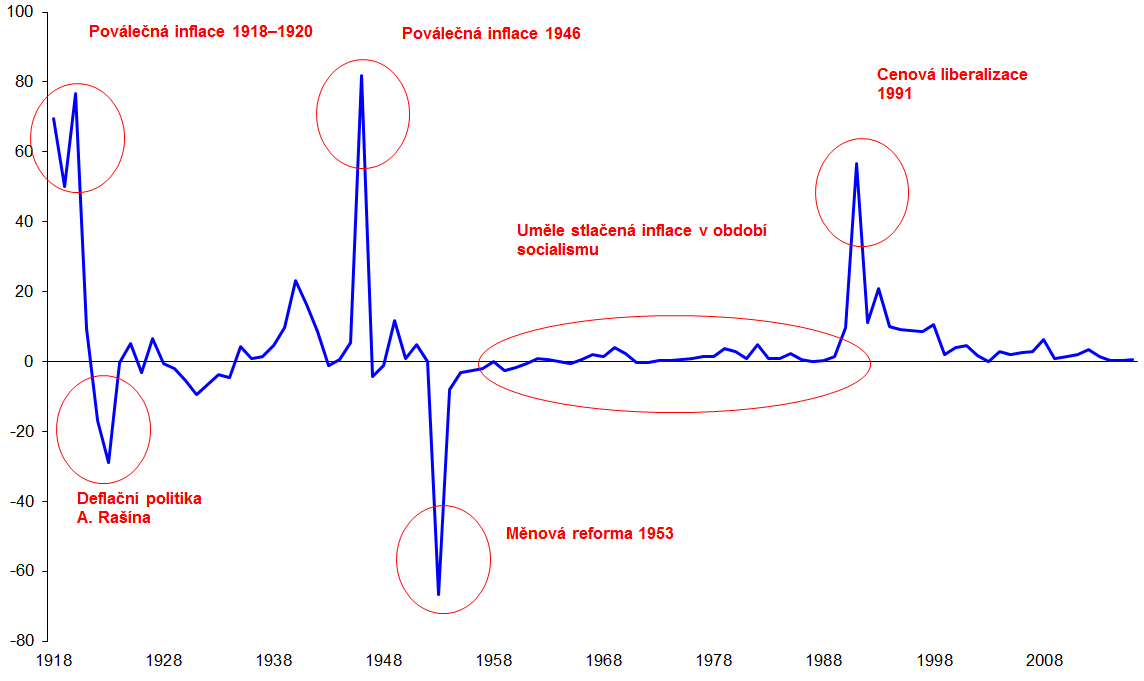
After the Second World War, inflation again shot up sharply, reaching almost 80%, and this inflation subsequently fell to about 70% deflation thanks to the currency reform of 1953. The last huge spike in inflation came in 1991, after the Velvet Revolution of 1989, when inflation reached around 55%.
Recent years have also been heavily affected, in particular by the covid pandemic, and inflation rose year on year. In 2022, inflation was 15.1%, and in 2023 it was 10.7%, making these the 2 most inflationary years since 1997. The rate of inflation is measured by the Czech Statistical Office.
Concrete examples of inflation
Below, we compare how much goods cost in 2000 and how much they cost in 2015. This is only a 15-year period, but even so you can see the drop in the purchasing power of money.
| Item | Price in 2000 | Price in 2015 |
| caraway bread (1 kg) | 14.80 CZK (about 0.68 USD) | 21.86 CZK (about 1.0 USD) |
| semi-skimmed pasteurised milk (1 l) | 12.54 CZK (about 0.58 USD) | 17.80 CZK (about 0.82 USD) |
| butter (1 kg) | 91.00 CZK (about 4.2 USD) | 142.90 CZK (about 6.6 USD) |
| diesel (1 l) | 26.67 CZK (about 1.2 USD) | 28.71 CZK (about 1.3 USD) |
| cinema ticket (1 adult admission) | 60.21 CZK (about 2.8 USD) | 123.75 CZK (about 5.7 USD) |
| bottled beer (0.5 l) | 7.61 CZK (about 0.35 USD) | 10.51 CZK (about 0.48 USD) |
| public transport ticket (1 piece) | 6.96 CZK (about 0.32 USD) | 11.96 CZK (about 0.55 USD) |
| vacuum cleaner (1 piece) | 3,563.00 CZK (about 160 USD) | 3,018.00 CZK (about 140 USD) |
If the topic of money interests you, take a look at this article of ours on nominal value too.
USD amounts are approximate, converted at the Czech National Bank rate of 21.80 CZK per USD on 2 October 2026.