
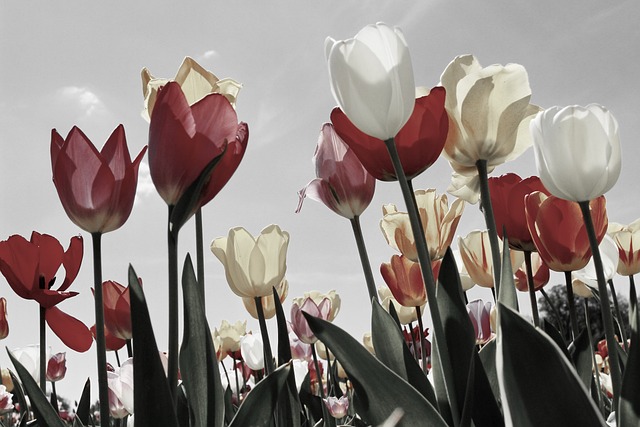

Do you like tulips? Today you can buy them at an ordinary florist’s for a price that will not put much strain on your wallet. You may be surprised to learn, however, that in the 17th century the value of a single bulb climbed so high that you could have bought an entire estate with it. How is that possible? In the following article, you will find out how the tulip crisis began and what it caused.
Are tulips rare?
The tulip is one of the most popular flowers. Do you know how it is grown? It produces bulbs. But before a plant grows from them and blooms, you will have to wait several months for the faster varieties. For the slower ones, it can take several spring seasons. There is, however, one more option: growing a tulip directly from seed. In that case, you may have to wait up to 12 years. After that, the flower lasts only a few years and then dies. What is more, it only blooms for a couple of weeks, sometime between March and May. From this point of view, the tulip may seem quite a rare plant. But could you really have bought an entire estate with one?
Tulips and the Golden Age
Let us travel back in time to the 17th-century Netherlands. This period is known as the Golden Age. Why? It is hardly surprising. Holland enjoyed a number of great successes at the time: the Dutch founded the first joint-stock company, invented the modern stock exchange and signed a declaration of independence. The Dutch were also successful in global trade. They traded in sugar and spices, for example. And in tulips. Tulips became a symbol of the Golden Age and of the country as a whole. They were associated with success and wealth and became a symbol of social status. So it will probably not surprise you that everyone wanted them.
Today, at a florist’s you can choose from tulips in all sorts of colours: white, red, yellow… But have you ever wondered how the striped ones come about? Few people know that the stripes are caused by the so-called mosaic virus. It may sound quite pretty, but infected plants often die because of it. A tulip infected in this way was very rare in the Golden Age. It existed only in limited numbers, partly because propagating an infected tulip once again produced only single-coloured flowers.

How the tulip crisis began
Let us stay in the 17th century for a little longer. Imagine that among the ordinary tulips in your garden you find one striped tulip. Because it is rare, you decide to sell it. You think to yourself: “Growing the whole flower bed cost me 10 florins, so I will sell my rare tulip for that price.” But then a buyer comes along and offers you 12 florins for it. He knows that it is unique and that he will not find one just anywhere. At the same time, he realises that he cannot take it with him yet, because it would die. The plant will only be ready to move after some time. So what you are actually selling is a commitment to hand over your carefully grown tulip to the buyer in the future at a pre-agreed price of 12 florins. On financial markets, this is called a futures contract and it is classed as a derivative.
Did you know?: The Aruban florin is the currency of Aruba, a country that is part of the Kingdom of the Netherlands. It is worth about 12 CZK (about 0.55 USD).
Now imagine that you have lots of acquaintances. Naturally, they all want your rare tulip. Your neighbour comes and offers you 25 florins for it. A few days later, a wealthy friend visits you and says he will take it for 50 florins. And so it goes on and on. As demand for a particular product rises, so does its price. This is one of the basic laws of economics: the law of demand.
Your friend pays a high price because he wants to own the rare tulip. Perhaps he simply likes it very much. But what if he understands your situation and wants to copy you and get the most out of it? Then he starts to speculate. He thinks: “I see, so he is making five times the tulip’s real price. Why shouldn’t I do the same? I bought it for 50 florins, so I will sell it for 250 florins.” Thousands of other people join your friend. And the price keeps rising. People no longer want the tulip just because it is pretty, but because they want to get rich from it. A speculative bubble forms.
A tulip for an entire estate and the consequences of tulip mania
At the peak of the tulip crisis in 1637, the price of a rare variety of this plant called Semper Augustus reached around 10,000 guilders. The guilder was the official currency of the Netherlands. The average annual wage of an ordinary labourer at the time was around 300 guilders. He would therefore have had to work for 33 years to afford such a rare tulip, assuming he had no expenses at all. As you can see, with that kind of money you could probably have bought an estate quite easily, couldn’t you?
But even a tulip has its limit, the maximum price that even the richest person is willing to pay for it. As soon as the price reaches that point, people get scared that they will never be able to sell the tulips they bought for large sums of money, and they start selling them in a panic. They want to get rid of them as quickly as possible, so they go far below the original price. Here the economic law works the other way round. Demand for the product falls sharply and supply rises, so its price drops steeply.
In the 17th century, the government tried to stop the crisis. Unfortunately, it did not succeed. The crisis had far-reaching consequences. No one came out of it unscathed. Even the lucky ones who managed to get rid of their tulips relatively early suffered heavy financial losses. Tulip mania left Dutch society very hesitant about investing for a long time afterwards.
You can watch the story of the tulip crisis in a YouTube video in English, which is the source of all the information in this article.
USD amounts are approximate, converted at the Czech National Bank rate of 21.80 CZK per USD on 2 October 2026.