


Thinking about how to keep your personal budget under control? Would you like to ensure a balance between your income and expenses and save a little extra? If so, try the 10-20-30-40 rule. Read the following article to find out what it means in practice and how you can use it.
The 10-20-30-40 rule in practice
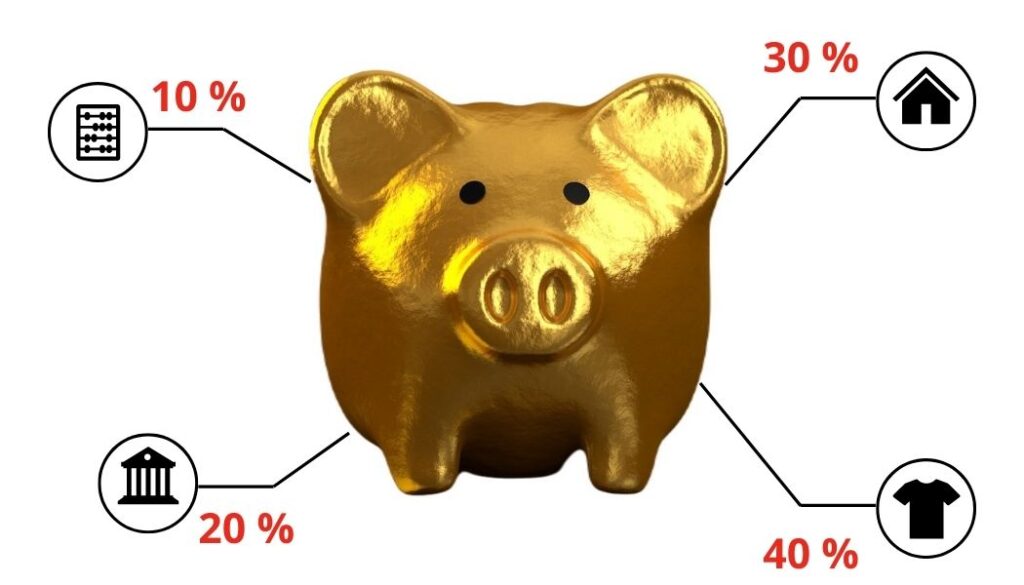
The 10-20-30-40 rule. Have you noticed that the numbers add up to 100? That is because it represents your total income. It is best to divide it into four piles. Ten percent should form your emergency fund, twenty percent savings, thirty percent housing costs and forty percent everyday spending.
How does the rule work in practice? Imagine it using the example of a family of four. For simplicity, let us choose someone with a higher family budget. For example, parents who together earn a net monthly income of about 4,600 USD. The children are still young, go to kindergarten and therefore have no income.
10% = emergency fund
The parents regularly send about 460 USD every month to their savings account. They want to be able to cover unexpected expenses such as a broken cooker or washing machine. They also feel more secure knowing they can stay at home for a few months if they plan to look for another job.
20% = savings
The parents love their children very much and want to help them stand on their own two feet in the future. Therefore, they send about 230 USD every month to each of them for building savings. They also think about their own future, so each of them pays about 230 USD per month into supplementary pension savings. In total, their savings amount to about 920 USD per month.
30% = housing costs
The family lives in a rented flat. The rent costs them about 920 USD per month. Added to this are energy and water costs, which together come to about 460 USD per month. In total, they pay about 1,400 USD per month for housing.
40% = spending
The rest of the monthly income goes towards everyday spending. This is getting higher and higher because the children are constantly growing and need larger clothes and shoes. Added to this is a new bike, ski equipment and so on. In addition, the parents pay for car expenses. When you add it all up, they spend about 1,800 USD per month on consumption.
Other options
If it suits you better, you can choose the 50/30/20 rule, which works on a similar principle. Fifty percent goes towards essential expenses such as housing, clothing, transport, food and the like. Thirty percent goes towards personal needs, meaning leisure time for you and your children. These are household expenses that you can do without, but it would be a great pity to cut them from the budget. The remaining twenty percent represents savings and investments, meaning those that can be used to build an emergency fund.
The rule will help you not only ensure a balance between income and expenses, build an emergency fund and reduce the risk of financial trouble, but also keep your spending under control. This way you will not spend money needlessly. At the same time, you can plan everything and reduce stress. Although this rule is recommended by experts, it is up to everyone to decide how to manage their finances. The 10-20-30-40 rule may suit someone, but not someone else. Therefore, always be guided by your options and needs.
You can read another specific example of this rule on Aktuálně.cz.