


Inflation is one of the words you hear most often today when people talk about the economy. It is a big topic, because all of us feel its effects in our wallets and bank accounts.
In this article, I will explain simply what inflation is, why it exists, how it arises, what its consequences are and how to cope with it.
What is inflation?
Inflation is an economic term for the rate at which the price level of products rises over a certain period, expressed as a percentage. It shows how quickly your money loses its real value. It is most often given as an annual figure, but you will also see quarterly and monthly figures. Your money keeps its nominal value (1,000 CZK (about 46 USD) will always be 1,000 CZK (about 46 USD)), but the number of products you can buy with it changes.
A simple example of inflation: a packet of cigarettes costs 100 CZK (about 4.6 USD). With inflation of 5%, the same packet should cost 105 CZK (about 4.8 USD) next year.
The most common method for tracking rising and falling prices is the “consumer basket” method. The basket generally represents everything people buy for everyday life (food, coffee, alcohol, clothing, fuel and so on). At regular intervals, the Czech Statistical Office buys this basket and in this way measures the inflation (across all sectors) that puts pressure on the value of our currency. This produces the figure you see everywhere on the internet, in newspapers and on television.
In practice, if you went to a shop today and did your usual shopping for 1,000 CZK (about 46 USD), and then wanted to buy exactly the same items in a month, a year or five years, you would look at the difference in how much you spent. We call this difference a “change in the price level”.
The change would be called inflation if you paid more for the same shopping or could buy fewer products. Deflation (the opposite of inflation) happens if your shopping became cheaper or you could buy more products. Deflation is not very common. In 2019, only 10 countries in the world had deflation (for example Saudi Arabia, Qatar, Panama, Iraq and Niger).
Why does inflation exist?
In most economically stronger countries, inflation is a desired and useful phenomenon. National banks set an inflation target in advance and take steps to reach it (by changing interest rates, printing and releasing new money and so on). The inflation target is usually 1 to 4%. The Czech National Bank (ČNB) targets 2%. This rate encourages people not to hoard money, because over time it simply loses value. At the same time, the loss of value is mild enough that saving for a holiday or a car still makes sense.
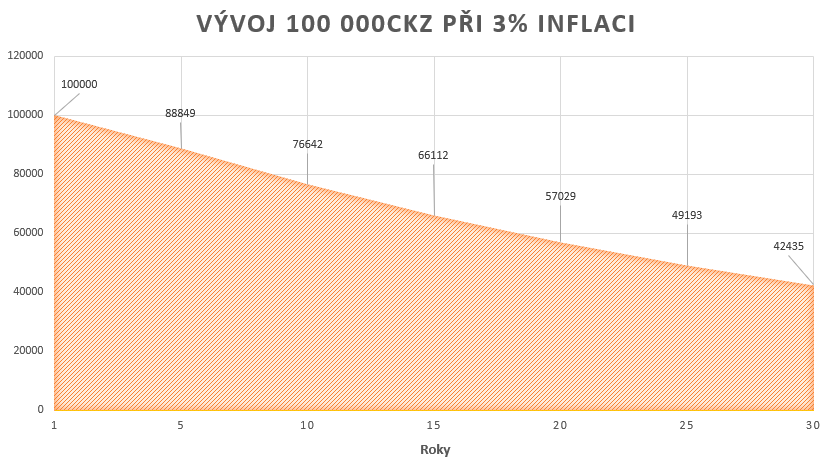
If you left 100,000 CZK (about 4,600 USD) sitting in a bank account with inflation at 3%, its real value after 3 years would be roughly 91,250 CZK (about 4,200 USD). Over the long term, this pushes the vast majority of people to spend or invest their money.
And that is exactly what the state wants. This spending keeps the wheels of the economy turning faster and faster, gross domestic product (GDP) rises, companies make higher profits and can therefore invest more in technological research and so on. This keeps us competitive on the international market and helps us keep pace with the rest of the world. If Germany had 5% inflation and we had none, over time their products would become unaffordable for us (they would be too expensive), and after a while our products would probably be unable to enter the German market (because their products could not compete with ours on price). In practice, the two countries would not be able to trade with each other.
Another, smaller reason for inflation is international debt. Today it is unimaginably large and almost impossible to repay. Everyone owes everyone, and nobody plans to pay these debts off. Countries simply do not demand repayment from each other, and over time the debts shrink thanks to inflation. The nominal value stays the same, but the real value (what you can buy with the money) falls.
Causes of inflation
The general cause of inflation is that the money supply grows faster than the production of goods. As a result, customers have more money relative to each product they buy, which, based on the basic relationship between supply and demand, pushes prices up (and so inflation occurs). The amount of money in circulation should match the growth in production (put simply, GDP growth), the involvement of foreign investors in the market, population growth or decline and so on. The Czech National Bank is responsible for estimating and printing the right amount of money.
Demand-side causes
Another cause is the way the Czech National Bank mentioned above influences interest rates. Commercial banks offer very cheap loans with interest of 1 to 3%, and there is strong demand for them. For banks, these loans are fairly safe, because low interest rates reduce the risk that borrowers will be unable to repay what they owe.
Loans are therefore very accessible and cheap, and many people take advantage of them. This brings in money that until then was not very active and now (assuming people borrow to buy something) naturally flows actively into the market. It reaches companies, which make a profit, invest it and pay their costs (to supplier companies, which in turn pay their costs, invest their profits and so on), and the cycle continues. Once again the amount of money in circulation increases, which naturally pushes prices up.
The third cause is falling returns on ordinary financial products. People usually have a lot of money in periods of low inflation, and the low returns force them to make a decision. There are 3 options in total: invest in assets (shares, bonds and so on), which causes inflation in exactly those assets. You can also leave your money sitting in a current or savings account. The last option is simply to spend the money.
Supply-side causes
Inflation can also come from the supply side. It is typically caused by rising product prices, not because of growing demand, but because of a shortage of goods. This happens, for example, when resources run out or become harder to obtain. We all clearly remember the recent oil shock, when fuel prices rose very quickly because of a shortage of Russian oil, which also had an inflationary effect on other products.
Many factors can cause supply-side inflation, but it is not a major problem. This kind of inflation is usually only temporary, and the market recovers from it quickly.
Effects of inflation
Positive effects
There are not many positive effects of inflation. I have already mentioned one of them above: the fall in the real value of state debts. The same thing happens on a smaller scale for ordinary people who have a loan. If the interest rate on your loan is lower than the inflation rate, you become relatively richer, while your lender becomes relatively poorer.
Negative effects
The easiest negative effect to see is definitely the rise in the price level. It goes hand in hand with a fall in the real value of our savings. This is followed by higher interest rates, which make credit and loans more expensive. A secondary negative effect is growing uncertainty in the markets, which discourages investment and slows the economy down.
Neutral effects
The main neutral effect is wage growth. On paper, it will seem that our lives are improving, but in real terms the money will buy roughly the same amount of products we could buy with our original salary before inflation changed significantly. So we earn more money, but we do not actually become any richer.
A look at the current situation in 2022-23
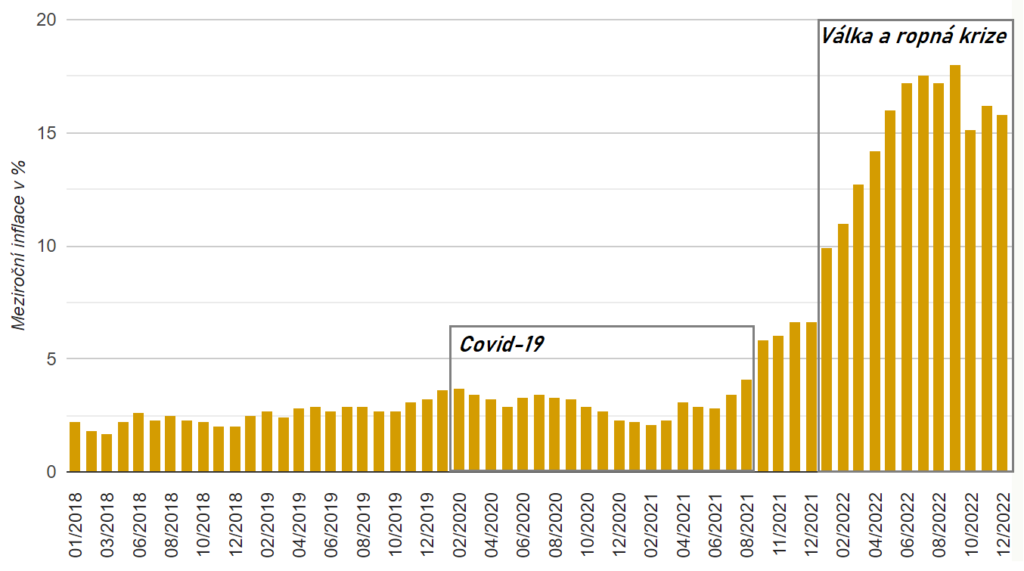
It might seem that the Czech National Bank is just trying to harm us when inflation here is much higher than its 2% target. But that is not the case. High inflation, such as in 2022, was not caused by the ČNB but by a series of “disasters” that triggered it. It all began with the Covid-19 pandemic, the lockdown and the general disruption of an economy that had been working very well until then. The economy took a second blow after Russia attacked Ukraine, both because of the need to supply Ukraine and its army and because of the breakdown in relations with Russia, which caused the so-called “oil shock” and then a wider energy commodities crisis. In this huge pool of problems, the ČNB and the national banks of other countries had to do as much as they could to save the situation, which cannot have been easy at all.
We can hope that no further disaster will hit us and that things will keep getting better. Inflation has stopped rising, which can be seen as a positive sign, but the battle is by no means won. At the moment, a lot depends on many factors, mainly on developments in partner countries, unemployment, the efficiency of our economy and so on.
USD amounts are approximate, converted at the Czech National Bank rate of 21.80 CZK per USD on 2 October 2026.
