

Dollar-Cost Averaging, shortened to DCA, is a simple strategy for buying assets (securities, currencies, commodities, or cryptocurrencies). It involves buying chosen assets regularly, regardless of their price. It is a relatively undemanding strategy that anyone can manage without problems! Let’s break down its advantages, disadvantages, risks, and everything else you need to know. You can read more about DCA here.
How does DCA work?
DCA is mainly suitable for long-term holding of securities or currencies that you plan to buy. It can also be helpful for shorter timeframes, but I don’t think it’s as effective as, for example, a Pullback strategy.
Let’s imagine you have 100,000 CZK (about 4,600 USD) that you want to invest in the market. You can simply do that immediately and all at once. You don’t need to deal with anything further, but you are taking the risk of a price decline and would therefore be holding assets at a loss.
DCA avoids this problem. It’s based on dividing your 100,000 CZK (about 4,600 USD) into portions and investing them gradually. For example, you divide the money into 20 portions of 5,000 CZK (about 230 USD) and buy them every first day of the month. This eliminates the risk of a sudden market crash. Your final purchase price will be close to the average price over the last 20 months.
Or, if you have a regular and consistent income from which you want to set aside money for investments each month, this method is perfect for you. From the moment you start buying, you simply add to your holdings, gradually increasing the value of your portfolio and averaging your purchase price.
DCA on the S&P 500
The most well-known stock index, the S&P 500, has an average annual return of 10% since its inception. If we adjust this figure for inflation, we get 7% per year. Not every year is profitable, but the S&P 500, with its nearly century-long history in the world of stocks, represents one of the safest options.
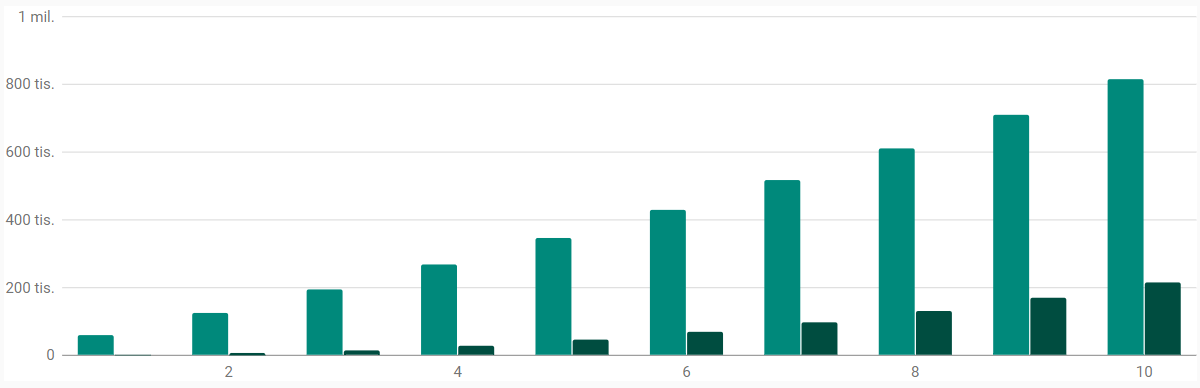
I have prepared a small example. If you set aside 5,000 CZK (about 230 USD) every month for 10 years into the S&P 500 and assume a 7% return, after the period expires, you would have a beautiful amount. Together, you would have set aside 600,000 CZK (about 28,000 USD) into the index, but the estimated value is over 800,000 CZK (about 37,000 USD)! And if you continue, the value of your investment portfolio would continue to grow exponentially.
Advantages
The biggest advantage is reducing risk. The investment market is not permanently growing, it is easy to lose money, and the most common mistake of beginners is buying at the wrong time. By investing money gradually, you eliminate many psychological barriers or fears that are difficult for inexperienced investors to identify. For example, you eliminate the feeling that you are missing out on something, that you are missing your chance, and so on.
I would put gradual averaging of the price in second place. When the market falls, you still have the opportunity to buy more, and in the long term, you get a more favourable entry price. At the same time, in most common cases, your loss will not be so large and you still have a chance to do something about it and not feel helpless. When the market rises, your “purchase” will be below the market price, and therefore you will be in profit. The more the market goes up, the higher your entry price will be, but if you stick to the strategy, you will continue to buy. Therefore, the profit in percentages will not be so attractive, but the amount of money will grow.
Long-term performance and historically good results are also important. If we focused solely on the S&P 500, which is very popular among DCA investors, their results aren’t shocking. Investing 5,000 monthly won’t get you a Lamborghini in 2 years, but that isn’t what this strategy aims to do. It simply puts your money in a place that, firstly, consistently outperforms inflation, which regularly diminishes its value, and secondly, gives you something extra. See the graph above.
Disadvantages and Risks
There aren’t many disadvantages or risks. The biggest disadvantage might be choosing this strategy when the market hits its bottom and turns into an upward trend. However, hitting that point is more luck than skill. Even people who make a living from trading can’t reliably identify these points. The long-term nature, which I mentioned as an advantage, could also be a disadvantage, depending on how conservatively you approach investments. If your goal is to become very rich very quickly, this method isn’t for you. Significant results won’t be seen for several years.
The biggest risk I personally see is choosing the wrong asset to apply your DCA strategy to. You can easily protect yourself against this by choosing a few more assets that you believe in for long-term growth, where you don’t see any major risks, and simply dividing your money between them.
Example
To avoid just painting a rosy picture, I’ve prepared an example of what a DCA would look like over the last 2 years. To put things in perspective, the S&P 500 has lost 10% of its value over the last 2 years. In 2022, it even lost 20%, and that doesn’t include the lowest point, but the price at which it ended the year 2022. To summarise, as we all know, the economy is currently struggling and in decline. This is the perspective you should take when looking at the following graph.
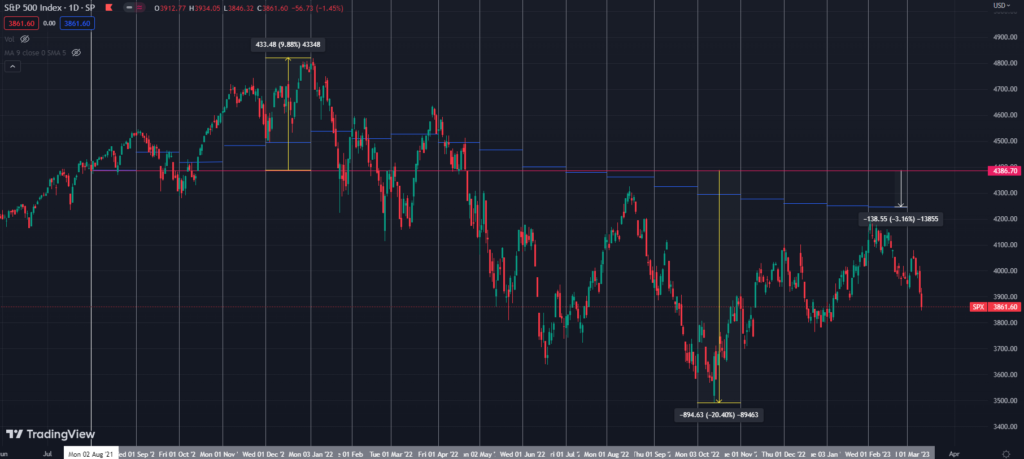
To explain the graph, the pink line shows the point where you would buy if you decided to make a one-off purchase with all your money. The blue lines demonstrate the development of your average purchase price.
The yellow vertical lines represent the deviation of the price from the start of the DCA; we reached a high of +10% and a low of -20%.
Finally, at the very end, you see a smaller white vertical line. This shows that DCA was more advantageous for you than a one-off purchase, by 3.2%. In monetary terms, you would theoretically gain 6,400 CZK (about 290 USD) thanks to DCA.
USD amounts are approximate, converted at the Czech National Bank rate of 21.80 CZK (about 1 USD) per USD on 2 October 2026.
