

Stock market speculation is a term every investor comes across sooner or later. However, people often do not know what it means or, even worse, confuse it with “investing”. In this article, I will explain what the term means and how it differs from investing, including its advantages and disadvantages.
Please do not be alarmed, but I will start with how investing itself works. Stock market speculation grew out of investing, so this is essential for a clear comparison.
How does investing work?
Investing means buying any kind of securities, commodities, cryptocurrencies and many other financial products. The investor owns these assets and hopes to profit from dividends, interest or simply a rise in the asset’s price, while taking on a certain level of risk (mainly the risk that the asset’s price falls).
Another typical feature is the long-term approach. Most investments are planned for more than one year. For this reason, investors carry out more thorough market research. They try to choose an asset they can trust over a longer time horizon. They watch how it is currently performing, whether market trends and conditions are helping it grow, and so on.
Most investments are made through so-called brokers. You can simply think of them as world-famous platforms such as the XTB app, eToro, Plus500 and similar.
How does stock market speculation work?
Here I will start somewhat from the end. Stock market speculation is for people who are looking for a faster way to make a profit and are willing to accept higher risk for it.

Risk
Leverage gives you the chance of higher profit combined with higher risk. Leverage on its own is seen as a very dangerous thing, because it lets you hold a position worth many times more than the capital you actually have. Leverage is not for everyone. Leveraged trading is time-consuming and stressful, and it requires a careful approach.
For example, if I bought 1,000 CZK (about 46 USD) of Tesla stock with 5x leverage (five times), my real exposure to Tesla stock would be 5,000 CZK (about 230 USD). The extra 4,000 CZK (about 180 USD) would be lent to me by the exchange, but I would be responsible for the risk. So if the stock fell by 10%, my loss would not be 100 CZK (about 4.6 USD) (the loss I would have without leverage), but 500 CZK (about 23 USD). In reality, I would lose half of the money I put into this speculation. The same applies the other way round, which is why people use leverage. Instead of a profit of 100 CZK (about 4.6 USD), you make a profit of 500 CZK (about 23 USD).
Some people call this style of trading gambling. From my personal experience, I can say that if you set clear rules and do not break them, you can easily calculate the risk in advance and decide whether it is worth it for you. However, I admit that your own psychology wears you down and you tend to break your rules, and that certainly turns into gambling.
How it really works
Last but not least, it is important to realise that when you speculate on the stock exchange, you do not own any asset. This is the biggest difference between speculation and investing. If I decide to invest, I actually own the assets and can do with them whatever I choose. But if I decide only to speculate on the same assets, my purchase never actually took place. The exchange simply records the price at which I decided to “buy” my position and only calculates the difference between this price and the current market price. It is pure maths; no assets were ever bought or sold.
I believe you have noticed one last small difference. Speculation does not take place with brokers, as most investing does, but on exchanges (whether commodity, securities or cryptocurrency exchanges, …). The best-known exchanges are ETRADE, Robinhood, TD Ameritrade and others.
Shorting
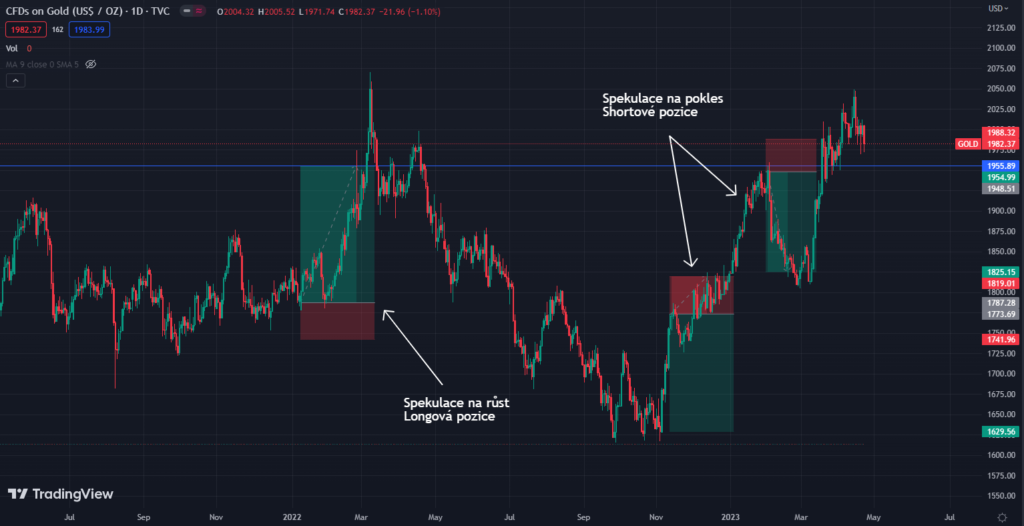
Stock market speculation offers one great opportunity. As I mentioned above, the exchange only calculates the difference between the entry price and the current price. So does it matter whether we speculate on a rise or a fall? It does not. You can make money even if you think the price of a particular asset will fall. When speculating on a rise, you borrow shares from the exchange and wait to see where the price goes. When speculating on a fall (so-called shorting), you borrow a share, sell it immediately and usually hold US dollars, euros or Czech crowns, and again wait to see what happens. You close the position by buying back the same amount of the asset and returning it to the exchange. (Again, the purchases and sales are purely theoretical and the exchange does not actually carry them out, but I am only adding this now to keep the explanation simple.)
So if you “short” an asset for 1,000 CZK (about 46 USD), its price falls to 850 CZK (about 39 USD) and you decide to close the position, you buy it back, the exchange gets exactly what it lent you and the 150 CZK (about 6.9 USD) difference is yours. Of course, you can use leverage here too and multiply both your profits and your risks.
The big risk of shorting compared with going long (the opposite, speculating on a rise) is that your long position cannot (unless you use leverage) fall by more than 100% (rock bottom, meaning a price of 0 CZK (about 0 USD)). You lose everything you put into the position, but that is where it ends. With shorting, this is not the case. The price of an asset you expected to fall can, in theory, rise without limit, so your maximum loss has no limit and you can get into huge trouble! If you ever do something like this, be careful and set a level at which you no longer want to hold the position, even at a loss, and accept the loss.
Summary
Stock market speculation offers many new possibilities that will certainly find their fans. The biggest advantages include the ability to speculate on a fall and the ability to hold a position many times larger than the value of your own capital invested in it. Of course, this brings higher risks and makes caution even more necessary. I would say that to succeed, it is absolutely crucial to keep an eye on the size of your risk and stick to rules you have set in advance.
In reality, what separates successful speculators from unsuccessful ones is the ability to predict how the market will develop. Many people see it as betting or flipping a coin. Personally, I do not fully agree with them, but at the same time I would say they are not that far from the truth, because the market really is unpredictable.
Fundamental and technical analysis are used to predict the market, and they are endless sources of information and ways of looking at market conditions. Personally, I have been involved in this discipline for more than a year, and I must confirm that the clear winners here are those with their own past experience. That is exactly why I would not recommend that any beginner speculate on exchanges. But if you cannot resist, most exchanges offer accounts with imaginary money that let you try everything out and gain at least some basic experience. However, trading with your own money is again something different from trading on a “demo account”. I can only recommend once more that you keep an eye on your risk and stick to a plan and rules set in advance. Good luck to the brave!
USD amounts are approximate, converted at the Czech National Bank rate of 21.80 CZK per USD on 2 October 2026.
