


We’ll walk through the forms using the example of Mrs Jarka, who had a short-term side job alongside her main employment contract (hlavní pracovní poměr, HPP) and decided to file her tax return online.
We pay tax on the following types of income:
- income from employment (dependent activity),
- income from self-employment (business activity),
- income from capital assets,
- rental income,
- other income.
TIP: I recommend the educational materials from the accounting firm UOL. You’ll find the e-book Income Tax for Ordinary People useful. It’s free to download.
Filing your tax return electronically means that:
- you sit down at a computer,
- you fill in the forms,
- you upload electronic certificates,
- you submit everything,
- you don’t go anywhere.
Well, you might go to the post office. I’ll explain that at the end of the article. You don’t have to go to the tax office (finanční úřad). You don’t have to submit paper certificates.
You’ll find all the electronic forms for the tax administration under this link. The portal is called My Taxes (Moje daně). I’ll put your mind at ease right away. It works and it’s simple!
There are 2 options:
- corporate income tax,
- personal income tax.
Are you a natural person or a legal entity?
You might be wondering what you are if you go to work and also rent out a flat. You’re a natural person. Even if you’re a freelancer, you’re a natural person.
Legal entities are organisations with legal personality. These include, for example, limited liability companies (s.r.o.), joint-stock companies (a.s.) or business companies (o.s.).
When does your employer settle your tax?
Your employer will settle your tax return for you if you:
- paid advance tax (zálohová daň) with only one employer at a time each month,
- had no income from business, capital income, rental income or other income exceeding 6,000 CZK (about 280 USD).
In tax terminology, you ask your employer for an annual tax reconciliation (roční zúčtování) of advances and tax credits.
Mrs Jarka worked at a petrol station from January to May. She took leave for the whole of May while also training for a new job at a hotel under a agreement to complete a job (dohoda o provedení práce, DPP) for 5,000 CZK (about 230 USD). She started at the hotel in June under a main employment contract (HPP). This accommodating step caused her a complication. She didn’t know whether her tax return would be handled by her current employer (the hotel’s payroll accountant), since she had 2 employers in May.
Jarka could choose between:
- Not including the income from the agreement in her tax return (possible with withholding tax (srážková daň), which is withheld from DPP earnings of up to 10,000 CZK (about 460 USD) a month) and asking her employer for an annual tax reconciliation. This would mean losing any right to a tax refund from the agreement.
- Preparing her tax return herself and including the income from the agreement in it.
Because Jarka had a lower income and paid mortgage interest all year, which reduces the tax base, she decided to prepare it herself.
Let’s look at how she went about it. What do you think? Did she make the right decision?
A practical example of filing a tax return electronically
Information needed to calculate Mrs Jarka’s tax:
- work at the petrol station from January to May (income 125,000 CZK (about 5,700 USD), advance tax 5,000 CZK (about 230 USD)),
- May training at the hotel under a DPP (income 5,000 CZK (about 230 USD), withholding tax 750 CZK (about 34 USD)),
- work at the hotel from June to December (income 210,000 CZK (about 9,600 USD), advance tax 16,000 CZK (about 730 USD)),
- she had a signed Personal Income Taxpayer Declaration (prohlášení poplatníka daně z příjmů fyzických osob) (the “pink form”) at the petrol station from January to May and at the hotel from June to December,
- a mortgage with 60,000 CZK (about 2,800 USD) in interest for the year.
Under the Personal income tax tab, she chose the link circled in the image.

Once opened, the electronic form has 3 parts:
- entry information,
- tax calculation, and
- a request for a refund of the overpayment.
You can see how Jarka filled in the tax calculation part in the next 4 images. Notice that the section with information about children is missing. Jarka doesn’t have children.
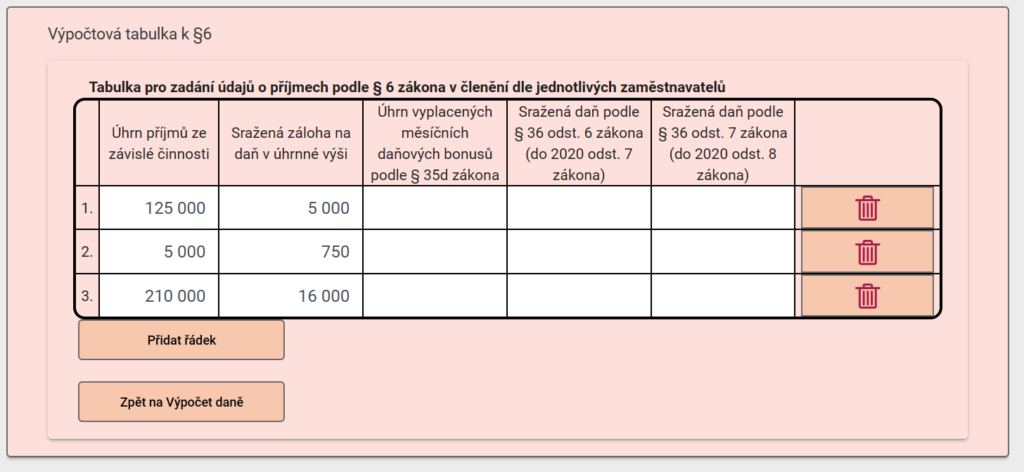
You’ll find your income and the tax advances withheld on the individual certificates of taxable income that each employer issues you.
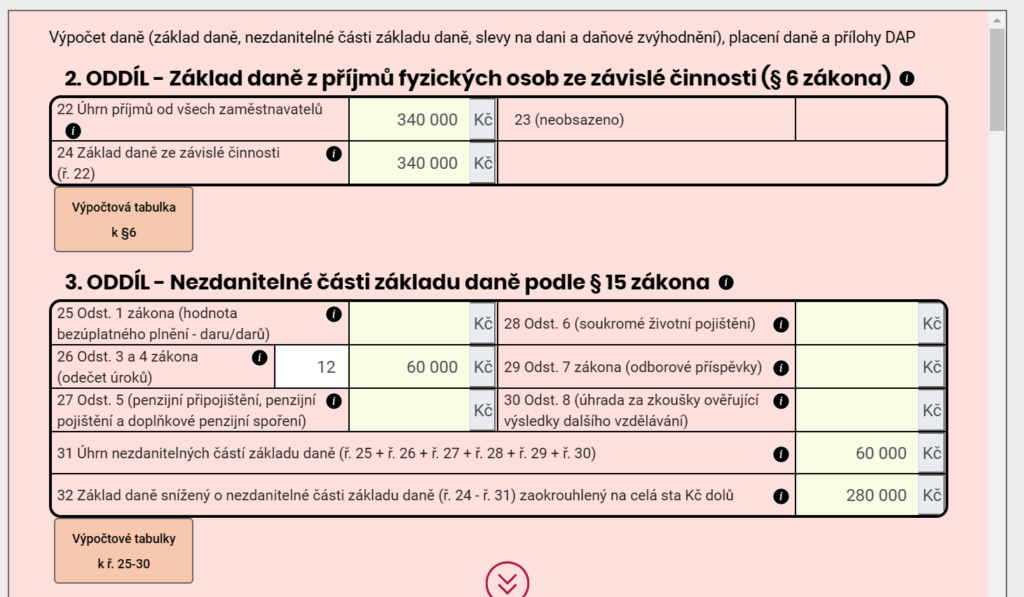


Jarka overpaid tax on her advances by 10,590 CZK (about 490 USD). The tax office will refund the amount to the account she stated in the next part of the return.
At the end of the tax calculation section there’s a place to upload certificates. Jarka photographed and uploaded:
- a certificate of taxable income from employment, tax advances withheld on this income and the tax credit from the petrol station,
- a certificate of tax withheld at the special withholding rate on this income from the hotel,
- a certificate of taxable income from employment, tax advances withheld on this income and the tax credit from the hotel,
- a certificate of payment of mortgage interest sent to her by the bank.
A final check and submission of the tax return followed. To stop anyone acting in Jarka’s name, she had to verify her identity. She printed the prepared form, signed it and sent it by post to the tax office address corresponding to her permanent residence. Jarka could also have verified herself with a bank identity (bankovní identita), a data box (datová schránka) or, for example, an electronic ID card (eObčanka).
Deadline for filing a tax return electronically
The deadline for submitting the 2022 tax return online is 2 May 2023. The deadline is typically in early May every year.
Jarka made the deadline comfortably and got back 750 CZK (about 34 USD) in tax from her side job at the hotel.
She made the right decision. Filing a tax return is easy. I’d even call it intuitive.
TIP: Thinking about starting a business? Read the guide that walks you through setting up a trade licence (OSVČ).
USD amounts are approximate, converted at the Czech National Bank rate of 21.80 CZK per USD on 2 October 2026.
