

Are you heading into the stock market and want to become a successful investor? You definitely cannot avoid the S&P 500 stock index. Find out in this article why it is so important for traders and what it actually represents!
The S&P 500 index
S&P 500 stands for Standard & Poor’s 500. It is a stock market index that tracks the performance and earnings of the 500 largest companies traded on US exchanges. It covers 70% of the market capitalisation of the US market. Together with the NASDAQ and the Dow Jones index, it makes up the trio of the most closely watched stock indices of all.
It is often seen as the best and most objective indicator of the state of the US stock market. However, it does not only include American companies, which is sometimes mentioned as a drawback. On the other hand, if the index is meant to include the absolute top performers, it cannot really pick and choose a company’s country of origin. That is why the rest of the world also contributes to the strength of the index. The S&P 500 gives investors a big advantage in diversification, because you are investing in 500 different companies at the same time.
To be included in the S&P, companies must meet 4 conditions:
– Be based in the US
– Most of the shares must be publicly traded
– The shares must be registered on the NASDAQ and NYSE exchanges
– Trading volume must exceed 250,000 shares a month
– Market capitalisation exceeding 4.6 billion USD

Origins and history
Its origins date back to 1923. The basis for the index came from a publication by Henry Poor, whose name it still carries today. The S&P was built on indices from Poor’s Publishing, which are no longer used today. Poor’s Publishing later merged with Standard Statistics, which gave rise to the S&P, though not yet in the form we know today. It used to include only 233 companies. In 1957, we could see the S&P for the first time in the form we have today. This change increased the number of companies included in the index. Since then, there have always been 500 of them. Within the index, companies are divided into categories, for example information technology, healthcare, the economy, energy, and so on.
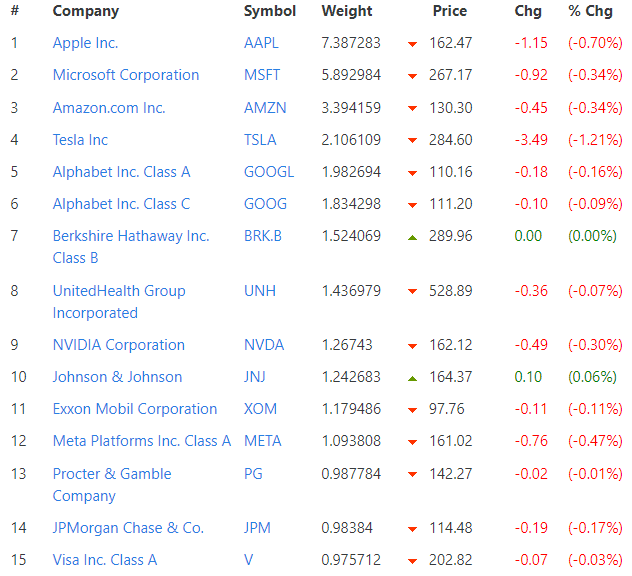
Today, the index’s value is made up of companies such as Apple, Google, Tesla, Visa, Facebook and 495 others. Experts say that the first ten companies have a majority share in how the index develops.
Why invest in the S&P?
The reason is fairly simple to explain. People invest to protect their money from inflation, which regularly erodes its value, and also to make a profit.
The S&P 500 is considered one of the safest investments when it comes to a longer time horizon. Throughout its entire history, the average profit from companies belonging to the S&P has been 9.8% a year (including dividends, roughly 2%). These are excellent results. These are trustworthy, strong and well-proven companies, which major investors such as Warren Buffett, John C. Bogle and many investment funds have also put their money into.
However, I must not forget, for example, the year 2008, when the S&P fell by more than 40%. Similar declines have repeated several times throughout history. In the world of investing, they are nothing unusual, and you need to be prepared for them.
How to buy the S&P?
You cannot buy the index itself, since it is really just an artificially calculated “score” for American companies. However, there are several ways to get hold of securities in these companies.
The first way
The first way is to buy shares in all the companies the index represents.
I would not recommend this method, because it is very costly and also time-consuming. However, you always have your shares under your own control, and you can buy more or sell any of them at any time. This method gives you complete freedom, at the cost of high expenses.
The second way
The second way uses ETFs (exchange-traded funds). ETFs are similar to mutual funds (which are not traded on an exchange). These ETFs let you invest in a large number of shares by buying just one. How does it all work? The fund collects money from investors and uses it to buy the shares included in the S&P 500. So everyone who owns a share in the fund owns, through it, a piece of a share in every company in the S&P. If the S&P index rises by 5%, the price of the fund’s share also rises by 5%.
ETFs are traded online, are very easily accessible, reliable, and everything happens within a few clicks. Some ETFs pay dividends (most often quarterly and annually).
The fund earns money from fees that do not exceed 0.1% a year, since managing the fund costs almost nothing.
The third way
The third way uses CFDs, contracts for difference. These are better suited to active investors for speculation and for hedging other positions in the market (hedging, used mainly by options traders or fans of leveraged trades).
The price of the contract equals the current value of the S&P index. A CFD contract works more on the principle of a bet, a prediction, than an investment as such. It is used over time frames of hours, or at most days, for active investors, traders. You are really buying a point on the chart and predicting whether the price will go up or down. In this case, you can also make money if the price falls, if you have “bet” on a decline. This is known as shorting.
You lend/exchange your money with the exchange for shares, which you then sell. The exchange keeps your money, and you have the money (probably dollars) you got from selling the shares, ready to buy back in at lower prices. If you manage to buy “more cheaply” this way, the exchange pays you the difference in prices. On the other hand, if you are wrong, you have to pay that difference yourself. This is a very risky way of trading, and a lot of people already see it as pure gambling. Here, I would urge caution. Only ever risk what you can afford to lose.

Summary
The S&P 500 offers a great opportunity for investors who are looking for a way to grow their money without exposing it to major risk. The S&P enjoys high investor confidence and has historically delivered great results, which is why it is so popular. In my opinion, it is the best choice for someone looking for an investment measured in years. And the current drop in price creates a great buying opportunity. If you decide to go this way, I would recommend the DCA method, dollar-cost averaging (for example, buying every month with a tenth of your capital). The S&P 500 is probably not the best choice for active investors, but it can still offer a sense of security that other investments may lack.
In closing, I would like to wish you a lot of luck and profit from your investments!
You might also be interested in the article about the monetary policy of the Czech National Bank (ČNB).
