


Do you need to put your savings somewhere, or do you simply not want them sitting in a current account at the bank, but you’d like them to grow? Then you’re in the right place to find out the difference between a term deposit and a savings account. These two products are similar in many ways, but very different in others.
These are defensive ways to grow your money, with a high degree of security for keeping your investment, but these products very often don’t even keep pace with inflation. They’re therefore only suitable for money you have further plans for. If you’re wondering which option will be better for you in your situation, read on.
What is a term deposit?
A term deposit works by depositing your money with a bank or credit union, and it grows for whatever period you choose. As a general rule, you can’t access the money during the period you chose at the start. The longer the period you deposit the money for, the higher the interest rate you usually get on your money. Banks offer various models:
- you can access the money only right at the end of the period you deposited it for
- for example, after a year the bank sends you only the money you earned in interest (e.g. you earned 5,000 CZK (about 230 USD) in interest on 100,000 CZK (about 4,600 USD) at 5% interest, so you receive 5,000 CZK (about 230 USD))
- after a certain time you can withdraw half of the total amount and leave the rest to keep earning interest (e.g. you chose a 10 year term deposit, after 5 years you withdraw half the money and leave the rest there)

Savings account
There’s no need for a lengthy introduction to a savings account. Many of us already have this product from our bank alongside our current account. Many banks now offer fairly solid interest rates (see the comparison below). This account works by transferring money you want to save, or want to keep separate from your standard account, from the current account you already have with your bank, and the bank offers you interest on it each year. You can access the money immediately. In some cases, you can even have a separate payment card. At some financial institutions, you don’t even need a current account for them to open a savings account for you.
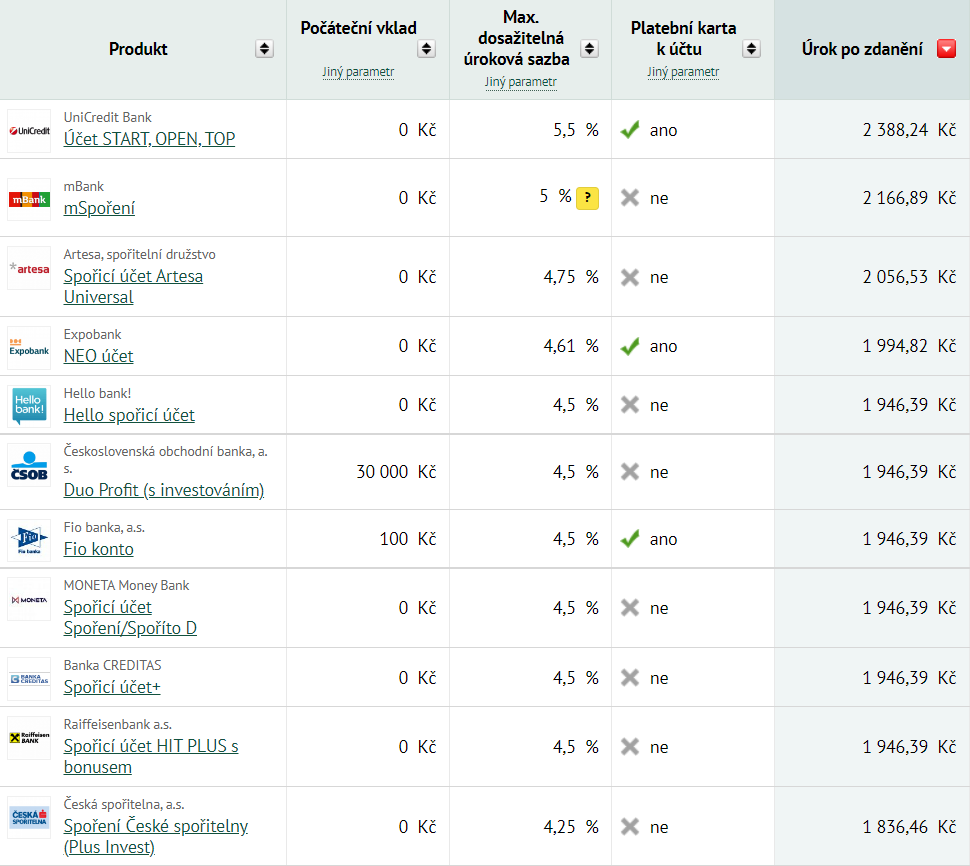
So which product is more worthwhile?
Both products are similar, yet they have major differences. We’ll list the pros and cons of both so you can decide what suits you.
Term deposit
Pros:
- a higher interest rate on your money (the more money you deposit, the more you earn)
- it stops you spending the money, because you simply can’t access it
- it protects your money from inflation (if you deposit a sufficiently large sum)
Cons
- if you urgently needed the money, you can’t get to it until the period it was deposited for has expired (or only for high fees)
- income from a term deposit is subject to 15% tax
Savings account
Pros
- you can access the money immediately
- in many cases banks offer interest similar to a term deposit (a range of 4 to 5%, see the comparison above)
- deposits aren’t conditional on a minimum amount, as is often the case with a term deposit
Cons
- if you struggle with spending, this account won’t protect your finances (check out tips on how to learn to save)
- some banks make opening a savings account conditional on opening a current account
- lower returns
With both products, your money is protected because it’s insured by law.
USD amounts are approximate, converted at the Czech National Bank rate of 21.80 CZK per USD on 2 October 2026.
